English
 中文简体
中文简体
Author: HUIRUI
Date: Apr 29, 2026
How to Make a Folding Stool: DIY Guide + Plastic Options
Content
- 1 Understanding the Folding Mechanism Before You Build
- 2 Materials and Tools Required for a Wooden Folding Stool
- 3 Step-by-Step: How to Make a Folding Stool
- 4 Key Dimensions: Getting the Proportions Right
- 5 Common Build Mistakes and How to Avoid Them
- 6 Plastic Folding Stools: What to Look for When Buying
- 7 DIY Wooden Stool vs. Plastic Folding Stool: Which Is Right for Your Needs
Making a folding stool at home is a realistic DIY project that requires basic woodworking tools, a small amount of hardware, and a clear understanding of the pivot-joint mechanism that allows the legs to collapse flat. The most practical homemade folding stool uses two X-frame leg assemblies connected by a fabric or wooden seat, with a single bolt or dowel pivot point on each side that allows the frame to fold completely flat in under two seconds. If you are considering a ready-made option instead, a plastic folding stool offers a lightweight, weather-resistant, and low-maintenance alternative that suits outdoor, kitchen, and workshop use—but the construction quality varies enormously by grade and manufacturer. This guide covers both: a full step-by-step build for a wooden folding stool, and a detailed breakdown of what separates a quality plastic folding stool from a cheap one.
Understanding the Folding Mechanism Before You Build
Every folding stool—whether wooden, metal, or plastic—works on one of two fundamental mechanisms. Choosing the right one before you cut a single piece of timber determines whether the finished stool is sturdy, safe, and genuinely easy to fold.
X-Frame (Scissor) Mechanism
The X-frame is the most common folding stool design. Two pairs of legs cross at a central pivot point on each side of the stool. When the seat is pressed down, the X opens and the legs splay outward to a stable angle—typically 15 to 25 degrees from vertical. When the seat is lifted, the X closes and the legs fold flat against each other. This design is mechanically simple, requires only one pivot bolt per side, and produces a stool that folds to a thickness of approximately 35 to 50 mm depending on timber dimensions.
A-Frame (Hinge) Mechanism
The A-frame design uses two upright leg pairs connected at the top by hinges and linked at a lower point by a stretcher that locks the open angle. This design is more stable under heavy lateral loads but folds less compactly than the X-frame. It is more commonly seen in folding chairs than stools, and the hinge hardware must be rated for the intended load—domestic piano hinges are typically rated at 20 to 40 kg per hinge pair, inadequate for a working stool without doubling up.
For a first build, the X-frame mechanism is strongly recommended: fewer parts, simpler joinery, and a more forgiving tolerance range for hand-cut woodworking.
Materials and Tools Required for a Wooden Folding Stool
A standard X-frame folding stool with a fabric seat requires modest materials. The following list covers a stool with a finished seat height of approximately 450 mm—standard stool height for use at a workbench or kitchen counter.
Timber
- 4 leg pieces: 600 mm × 35 mm × 20 mm each, cut from hardwood (beech, oak, or ash) or structural pine. Hardwood is preferred—it holds the pivot bolt without splitting under repeated stress cycles. Avoid softwood below 30 mm width as it will split at the pivot hole over time.
- 2 seat support rails: 280 mm × 35 mm × 20 mm, connected to the top of each leg pair and serving as the attachment point for the seat.
Hardware
- 2 × M8 bolts, 60 mm length, with washers and nylon lock nuts—one per X-frame pivot. M8 is the minimum practical diameter; M10 is preferable for a stool rated above 100 kg.
- 4 × M5 bolts or wood screws for attaching seat fabric or wooden seat panel to the support rails
- 4 rubber or felt foot pads, self-adhesive, 25 mm diameter—prevent floor scratching and add stability on smooth surfaces
Seat Material
- Canvas or heavy-duty webbing, approximately 300 mm × 300 mm, for a fabric sling seat—the simplest option, requires no rigid seat panel
- Alternatively: a 280 mm × 200 mm × 18 mm plywood panel for a rigid seat with optional foam and fabric covering
Tools
- Hand saw or mitre saw for cutting timber to length
- Drill with 8 mm and 5 mm bits (matching bolt diameters)
- Spanner or socket set for tightening nylon lock nuts
- Sandpaper (80 grit and 120 grit) for finishing cut edges
- Pencil, tape measure, and square for accurate marking
Step-by-Step: How to Make a Folding Stool
Follow these steps in sequence. The most critical step is the pivot hole placement—an error of more than 3 to 4 mm in hole position between the two legs in each X-pair will cause the frame to bind or sit unevenly when open.
- Cut all timber pieces to length. Using your saw and a square, cut four leg pieces to 600 mm and two seat rails to 280 mm. Sand all cut ends with 80-grit paper to remove splinters, then follow with 120-grit for a smooth finish. Round the bottom corners of each leg piece slightly to prevent floor gouging when the stool is dragged.
- Mark and drill the pivot holes. This is the most important step. Lay two leg pieces side by side and mark the pivot hole position at exactly the midpoint of each leg's length—at 300 mm from each end. The holes in both legs of each X-pair must align perfectly. Clamp both legs together and drill through both simultaneously with an 8 mm bit to guarantee alignment. Drill slowly and use a backing piece of scrap wood underneath to prevent tear-out on the exit face.
- Drill the seat rail attachment holes. At the top end of each leg piece, drill a 5 mm hole at 15 mm from the end, centred on the width. These holes will be used to bolt or screw the seat rails to the top of the leg frame.
- Assemble the X-frames. Place one leg piece flat on your work surface. Lay the second leg piece across it at the pivot point so both pieces cross at their midpoints and the tops and bottoms align symmetrically. Insert the M8 bolt through both holes with a washer on each side (washer against wood on both faces), then thread on the nylon lock nut. Tighten until the joint is snug but the legs can still pivot smoothly—overtightening binds the joint; undertightening allows lateral wobble. Repeat for the second X-frame.
- Attach the seat rails. Open both X-frames to the working angle (approximately 20 degrees from vertical gives a stable base with good seat height). Lay them parallel, approximately 250 mm apart. Attach one seat rail across the top of the front legs of both frames, and one rail across the top of the rear legs, using M5 bolts or screws through the pre-drilled holes. Do not glue these joints—the stool needs to flex slightly as it opens and closes, and rigid glued joints will crack under load.
- Attach the seat. For a fabric sling seat: cut your canvas or webbing to 320 mm × 320 mm, fold 20 mm hems over each seat rail, and staple or screw through the hem into the rail face. Pull the fabric taut before securing the second rail—slack fabric reduces sitting comfort and concentrated load on one fixing point. For a rigid plywood seat: cut to 280 mm × 220 mm, sand smooth, optionally cover with 20 mm foam and fabric, then screw down through countersunk holes into both seat rails.
- Apply finish and foot pads. Sand all external surfaces with 120-grit paper, then apply two coats of hardwax oil, Danish oil, or exterior varnish for durability and water resistance. Allow full cure time (typically 24 to 48 hours between coats depending on product). Attach rubber foot pads to all four leg bottoms once the finish is fully cured.
- Load test before use. Before sitting on the stool, apply a static load of approximately 1.5 times the intended user weight by placing weighted objects on the seat for 10 minutes. Check all joints for movement, cracking, or bolt rotation. Retighten any hardware that has shifted.
Key Dimensions: Getting the Proportions Right
The dimensions given above produce a stool suited to adult use at a standard work surface. Adjust them as follows for different applications:
| Application | Leg Length | Finished Seat Height | Recommended Timber Width |
|---|---|---|---|
| Children's stool (age 4–8) | 400 mm | ~300 mm | 25 mm |
| Standard adult stool | 600 mm | ~450 mm | 35 mm |
| Bar / kitchen counter height | 800 mm | ~600 mm | 40 mm (M10 bolt) |
| Heavy-duty workshop stool (120 kg+) | 600 mm | ~450 mm | 45 mm hardwood (M10 bolt) |
Common Build Mistakes and How to Avoid Them
First-time stool builders consistently encounter the same set of problems. Knowing them in advance prevents wasted timber and frustrating rebuilds:
- Misaligned pivot holes: If the pivot holes are not at exactly the same position on both legs of an X-pair, one leg sits higher than the other when the stool is open, producing a rocking frame. Always drill both legs clamped together, never individually.
- Over-tightened pivot bolts: A bolt tightened too firmly crushes the wood fibres around the hole over time, causing the joint to loosen after a few weeks of use. Use nylon lock nuts tightened only to the point where the pivot moves without play—finger-tight plus a quarter turn with a spanner is usually correct.
- Pivot holes too close to the end of the leg: A hole drilled less than 40 mm from the end of a 35 mm wide timber creates very little wood surrounding the hole, which splits under load. The pivot should always be at the midpoint of the leg length.
- Seat fabric not pulled taut: Loose fabric sags under load and concentrates stress on the attachment fixings at the centre of the rail rather than distributing it across the full width. Pull the fabric firmly before securing the second rail and test by pressing down firmly with your hand before sitting.
- Using green or undried timber: Freshly cut or unseasoned timber shrinks as it dries, loosening joints and warping the frame. Always use kiln-dried timber with a moisture content below 12% for furniture construction.
Plastic Folding Stools: What to Look for When Buying
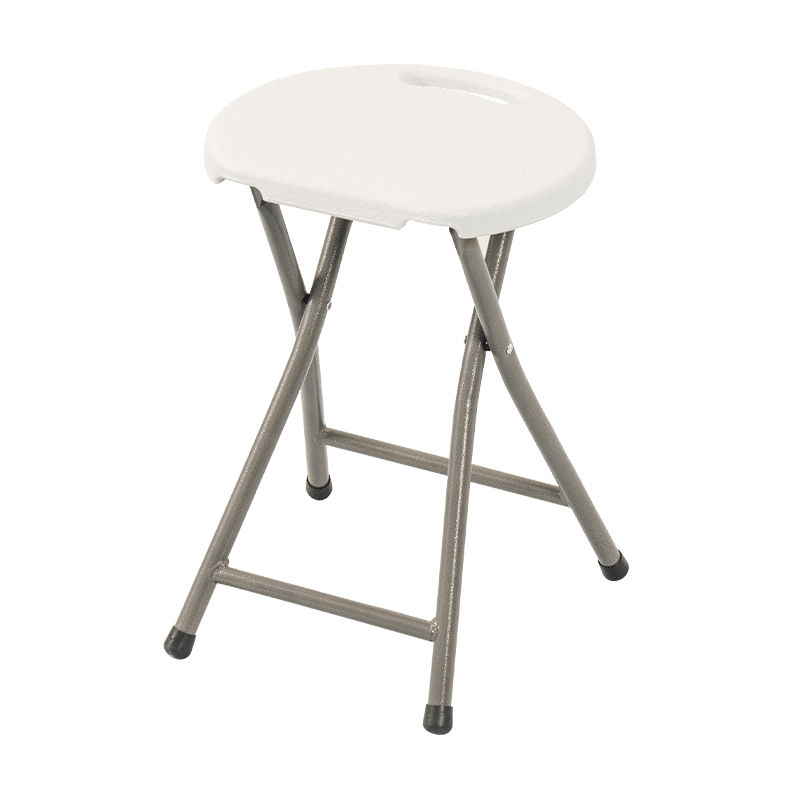
A plastic folding stool offers advantages that a homemade wooden stool cannot match: it is typically 30 to 50% lighter (most weigh 1.2 to 2.5 kg), completely weather and moisture resistant, and requires no finishing or maintenance. However, quality varies significantly across the market, and a cheap plastic stool that fails under load poses a real injury risk.
Polypropylene vs. High-Density Polyethylene (HDPE)
Most plastic folding stools are made from either polypropylene (PP) or HDPE. Polypropylene is the preferred material for structural seating applications—it has a higher flexural modulus than HDPE (approximately 1,500 to 2,000 MPa vs. 800 to 1,000 MPa for HDPE), meaning it is stiffer and deforms less under sustained load. Glass-fibre reinforced polypropylene, used in premium stools, offers even greater rigidity and a rated load capacity of 150 to 200 kg compared to 100 to 130 kg for standard polypropylene.
Hinge and Pivot Quality
The weakest point of any plastic folding stool is the pivot joint. In budget models, the pivot is a simple plastic-on-plastic pin that wears oval after repeated folding cycles, introducing lateral wobble. Quality stools use either stainless steel pivot pins pressed into reinforced nylon bushings, or glass-filled nylon pivot assemblies that maintain close tolerances over thousands of fold-unfold cycles. When evaluating a stool in a shop, open and close it several times and check for any lateral play in the pivot—any movement at this stage will only increase with use.
Seat Thickness and Ribbing Pattern
A flat, thin plastic seat panel without structural ribbing will flex and potentially crack under body weight. Quality plastic folding stools use injection-moulded seats with a ribbed or honeycomb underside structure that dramatically increases stiffness without adding weight. The seat surface should have a minimum wall thickness of 4 to 6 mm at its thinnest point, and the underside ribs should be at least 8 to 12 mm deep to provide adequate bending resistance.
Anti-Slip Features and Foot Design
Plastic stools on smooth floors can be hazardous if the feet lack adequate grip. Look for stools with rubber foot inserts or co-moulded rubber overmould on the foot contact surfaces. Some premium stools incorporate a rubber grip strip across the full width of the bottom rail—this distributes the contact area and significantly reduces the risk of the stool sliding on tiles or polished concrete.
DIY Wooden Stool vs. Plastic Folding Stool: Which Is Right for Your Needs
Both options have genuine advantages depending on intended use. The comparison below helps clarify the decision:
| Factor | DIY Wooden Stool | Plastic Folding Stool |
|---|---|---|
| Cost | £8–£20 in materials | £10–£60 retail |
| Weight | 1.5–3.0 kg | 1.2–2.5 kg |
| Weather resistance | Moderate (needs finishing) | Excellent (inherent) |
| Customisable dimensions | Fully customisable | Fixed sizes only |
| Repairability | Easily repaired | Limited (pivot wear, cracks) |
| Aesthetic quality | High (natural wood) | Functional / utilitarian |
| Time to ready | 3–5 hours build + cure time | Immediate |
| Tools required | Saw, drill, spanner | None |
Build your own if you want a stool sized to specific dimensions, enjoy the craft process, want a natural aesthetic, or need a heavy-duty stool rated beyond the standard plastic options. Buy a plastic folding stool if you need it immediately, want outdoor or wet-environment use without maintenance, or need multiple identical stools at low cost for events or storage-constrained spaces.
Featured Products Showcase