English
 中文简体
中文简体
Author: HUIRUI
Date: Jun 17, 2026
How to Make a Folding Stool: DIY Guide vs. Plastic Folding Stool Alternatives
Content
- 1 What You Need Before Building a Folding Stool
- 2 Step-by-Step: How to Make a Folding Stool
- 3 Common DIY Folding Stool Mistakes and How to Avoid Them
- 4 Plastic Folding Stool: When to Buy Instead of Build
- 5 DIY Folding Stool vs Plastic Folding Stool: Side-by-Side Comparison
- 6 What to Look for When Buying a Plastic Folding Stool
- 7 Folding Stool Variations Worth Considering
- 8 Safety Checks Before Using Any Folding Stool
You can make a functional folding stool at home using basic woodworking tools, two pairs of crossed legs, a seat board, and a pivot bolt — total material cost runs $10–$30 for a wooden DIY version. If you need something lighter, more weather-resistant, and ready in minutes, a manufactured plastic folding stool is the practical alternative, typically weighing 1.5–3 kg and supporting 100–150 kg at a retail price of $15–$60. This guide covers both paths: a detailed DIY build process and a clear-eyed comparison of when a plastic folding stool makes more sense.
What You Need Before Building a Folding Stool
A folding stool works on a simple scissor-hinge principle: two X-shaped leg frames pivot at a central bolt, collapsing flat when not in use and locking open at a stable angle under load. Before cutting any wood, gather the right materials and confirm your target dimensions.
Recommended Materials
- Lumber: 18–22 mm thick hardwood (beech, oak, or poplar) or high-quality 18 mm plywood for the seat board. Leg rails work well in 20×40 mm or 25×50 mm rectangular section.
- Pivot hardware: One M8 or M10 carriage bolt per X-frame, with matching washers and a nylon lock nut. Two pivot points total for a standard two-frame stool.
- Hinge cord or dowel: A nylon cord or a fixed wooden dowel between the front and rear feet limits how far the stool opens, preventing overextension and collapse.
- Seat fasteners: 4–6 wood screws (M4 × 30 mm) or threaded inserts to attach the seat board to the leg frames.
- Finish: Sandpaper (80, 120, 180 grit), wood stain or paint, and a clear protective topcoat (polyurethane or oil) for durability.
Target Dimensions for a Standard Folding Stool
| Component | Recommended Dimension | Notes |
|---|---|---|
| Seat height (open) | 430–480 mm | Standard adult sitting height |
| Seat board width | 260–300 mm | Wider = more comfort, heavier |
| Seat board depth | 200–240 mm | Front-to-back |
| Leg rail length | 550–620 mm each | Cut identically for all 4 rails |
| Pivot bolt position | Center of leg length (275–310 mm from top) | Must be identical on both rails |
| Open foot spread | 300–360 mm | Controlled by limiting cord/dowel |
| Folded thickness | 50–70 mm | Depends on seat and leg thickness |
Step-by-Step: How to Make a Folding Stool
The following steps describe building a classic two-frame scissor folding stool — the most common and stable DIY design, suitable for adults up to 100 kg when built with quality hardwood.
Step 1 — Cut the Leg Rails
Cut four leg rails of identical length (550–620 mm) from your chosen timber. Sand all faces to 120 grit. Mark the exact center of each rail — this is where the pivot bolt will pass through. Use a drill press or a carefully guided hand drill to bore a clean hole 1–2 mm larger than your bolt diameter (e.g., 10 mm hole for an M8 bolt) at this center mark. Precision here is critical: misaligned pivot holes cause the stool to rack and wobble.
Step 2 — Shape the Leg Ends
The top ends of the inner rails (which connect to the seat) and the bottom ends of all four rails (which contact the floor) should be angled slightly. A 10°–15° angle cut at the foot of each rail ensures all four feet contact the floor flat when the stool is open. Round or chamfer all sharp corners with sandpaper to prevent splintering in use.
Step 3 — Assemble the X-Frames
Pair the rails into two X-frames. For each frame, place two rails in a cross pattern (one in front, one behind), aligning the center pivot holes. Slide a carriage bolt through both holes, add a flat washer on each side, and thread on a nylon lock nut. Tighten firmly but not so tight that the joint cannot pivot smoothly — the legs must swing freely with light resistance. Repeat for the second X-frame.
Step 4 — Cut and Prepare the Seat Board
Cut the seat board to your target width and depth (260–300 mm × 200–240 mm). Round the front edge with a router or sandpaper to reduce pressure on the back of the thighs. Sand progressively through 80, 120, and 180 grit. If using solid wood, consider adding a small chamfer or bevel around the entire perimeter for a finished appearance.
Step 5 — Attach the Seat to the X-Frames
Stand both X-frames upright at your target open angle. Position the seat board across the top of the two inner (front) rails, centered side-to-side. The seat attaches only to the two upper ends of the front rails — the rear rails remain free to pivot, which is what enables the folding action. Pre-drill pilot holes to prevent splitting, then screw down with M4 × 30 mm wood screws. Alternatively, use barrel nuts and machine bolts for a removable, adjustable connection.
Step 6 — Install the Limiting Cord or Dowel
Without a limiter, the stool will collapse flat the moment weight is applied — or overextend dangerously. Thread a length of nylon cord or paracord between the front foot of one frame and the rear foot of the other, at a length that holds the stool open at your target angle (typically 55°–65° between the leg rails). Knot securely and burn the ends to prevent fraying. Alternatively, a fixed cross-dowel glued between the inner faces of the foot rails achieves the same result more rigidly.
Step 7 — Sand, Finish, and Add Foot Pads
Final-sand all surfaces to 180 grit. Apply your chosen finish — two coats of tung oil or polyurethane provide good protection for indoor use; exterior-grade varnish or paint is better for outdoor or garage use. Stick self-adhesive rubber furniture pads to each foot to prevent floor scratching and add slip resistance. Allow finish to cure fully (24–48 hours minimum) before loading the stool.
Common DIY Folding Stool Mistakes and How to Avoid Them
Most DIY folding stool failures come down to a small set of avoidable errors. Here are the most frequent problems and their fixes:
- Misaligned pivot holes: Even a 1–2 mm offset between the two holes in an X-frame causes the legs to bind or twist. Always clamp the two rails together and drill through both simultaneously.
- No limiting cord: Forgetting to install a foot-spread limiter results in a stool that collapses under load. This is the single most common safety failure in homemade folding stools.
- Seat attached to both rail sets: If the seat is screwed to both the front and rear rail tops, the stool cannot fold. The seat must connect only to one pair of rail ends (front or rear), not both.
- Soft wood that compresses at the pivot: Using pine or MDF at the pivot point leads to the bolt pulling through the wood over time. Reinforce with metal washers at least 30 mm in diameter, or use hardwood at the pivot zone.
- Unequal leg lengths: Even 1 mm of difference between the four legs causes rocking. Always cut all four rails from a single template or jig.
Plastic Folding Stool: When to Buy Instead of Build
A plastic folding stool is the better choice in several practical scenarios. Understanding the trade-offs helps you decide which path is right for your situation.
Advantages of Plastic Folding Stools
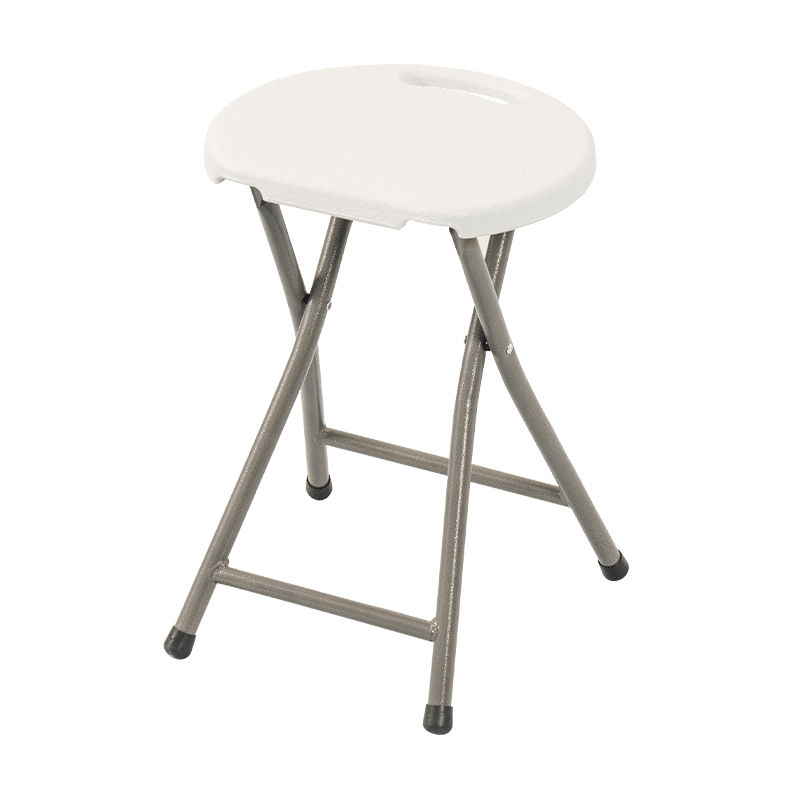
- Lightweight: Most polypropylene folding stools weigh between 1.5 and 2.5 kg, compared to 3–5 kg for an equivalent hardwood DIY stool. For camping, travel, or events where you carry the stool, this matters significantly.
- Weather resistance: Injection-molded polypropylene (PP) or high-density polyethylene (HDPE) does not absorb water, warp in humidity, or rot. Wood stools require sealing and periodic refinishing for outdoor use.
- Zero assembly time: A purchased plastic folding stool is ready to use out of the box. A DIY build requires 4–8 hours of work across multiple sessions.
- Consistent load ratings: Quality plastic folding stools are tested to EN 1022 or BIFMA X5.1 standards, with rated capacities of 100–150 kg. A DIY stool's capacity depends entirely on the builder's material choices and joint quality.
- Easy to clean: Plastic wipes clean with a damp cloth. Wood requires more care around water to prevent staining and swelling.
Where Plastic Folding Stools Fall Short
- Cheap plastic stools with thin legs and no steel reinforcement can crack or flex dangerously at loads above 80–90 kg, even if rated higher.
- Budget plastic stools have a short lifespan in UV-exposed outdoor settings — untreated polypropylene becomes brittle after prolonged sun exposure.
- A DIY wooden stool can be customized for height, width, finish, and aesthetic in ways that off-the-shelf plastic options cannot match.
DIY Folding Stool vs Plastic Folding Stool: Side-by-Side Comparison
| Feature | DIY Wooden Folding Stool | Plastic Folding Stool |
|---|---|---|
| Cost | $10–$30 (materials only) | $15–$60 (ready to use) |
| Build time | 4–8 hours | 0 minutes |
| Weight | 3–5 kg | 1.5–2.5 kg |
| Load capacity | 80–120 kg (build-dependent) | 100–150 kg (certified) |
| Outdoor suitability | Moderate (requires sealing) | Good (UV-treated PP/HDPE) |
| Customization | Full (size, finish, color) | Limited (stock sizes/colors) |
| Aesthetic | Warm, natural, premium | Functional, utilitarian |
| Durability | 10–20+ years (hardwood) | 5–15 years (quality brands) |
| Tools needed | Saw, drill, sandpaper, clamps | None |
What to Look for When Buying a Plastic Folding Stool
Not all plastic folding stools offer the same structural integrity. These are the factors that separate a safe, long-lasting stool from a cheap one that cracks under load:
- Material grade: Look for glass-filled polypropylene or high-impact HDPE rather than generic "plastic." Glass-filled PP is typically 30–40% stiffer and stronger than unfilled PP, and resists creep (slow deformation under sustained load) far better.
- Steel-reinforced legs: Quality plastic folding stools embed steel tubes or rods inside the plastic leg shafts. This prevents lateral flex and sudden leg failure — look for this feature explicitly in the product description or spec sheet.
- Certified load rating: A stool that lists EN 1022, ANSI/BIFMA X5.1, or equivalent standard certification has been independently tested. A weight rating without a testing standard is a marketing claim, not a safety assurance.
- Non-slip feet: Rubber or TPE foot caps prevent the stool from sliding on smooth floors, which is the most common cause of tip-over accidents on hard flooring.
- UV stabilizer additive: For outdoor use, confirm the plastic contains UV stabilizers. Unstabilized polypropylene starts to chalk and crack after as little as 12–18 months of direct sun exposure.
- Seat texture: A lightly textured or ribbed seat surface improves grip when sitting and prevents the user from sliding forward, particularly in warm weather when contact between skin and smooth plastic becomes slippery.
Folding Stool Variations Worth Considering
Once you understand the basic scissor-hinge design, several proven variations offer additional functionality:
Step Stool Version
Increasing the seat height to 550–600 mm and widening the foot spread to 400 mm creates a step stool suitable for reaching shelves. For DIY builds, add a second cross-brace between the inner rails at mid-height for additional rigidity at the taller profile.
Padded Seat Version
Gluing a 20–30 mm layer of medium-density foam (density 30–40 kg/m³) to the seat board and covering it with vinyl or canvas fabric transforms the basic stool into a comfortable padded seat. Use contact cement for the foam layer and a staple gun for the fabric, pulling the cover tight before stapling to avoid wrinkles.
Backpack-Friendly Compact Stool
Reducing leg rail dimensions to 15×30 mm and using aluminum bar stock instead of wood produces a stool that folds to 40 mm thick and weighs under 1.5 kg — suitable for hiking and outdoor events. This approach works better as a purchased product (ultralight camping stools start around $20–$35) than as a DIY project, as drilling and bending aluminum accurately requires more specialized tools.
Safety Checks Before Using Any Folding Stool
Whether you built the stool yourself or purchased a plastic folding stool, run through these checks before first use and periodically thereafter:
- Check pivot bolt tightness: The pivot bolt should be snug enough that the joint has slight resistance but still pivots freely. A loose bolt allows the X-frame to wobble laterally; an over-tightened bolt prevents the stool from opening fully.
- Verify all four feet contact the floor: Place the stool on a flat surface and press each corner. All four feet should be in simultaneous contact. A rocking stool is a tip-over risk.
- Test the foot-spread limiter: Open the stool fully and confirm the limiting cord or dowel is intact and taut at the fully open position. A missing or broken limiter makes the stool unsafe to load.
- Inspect for cracks (plastic) or splits (wood): On plastic stools, check the leg joints and pivot area for hairline cracks, which are a sign of imminent failure. On wooden stools, check for splits along the grain near the pivot holes and seat attachment screws.
- Confirm the seat is secure: Attempt to shift the seat laterally and front-to-back before sitting. Any movement in the seat-to-frame connection requires tightening or re-fastening before use.
Discard any folding stool — plastic or wooden — that shows cracking at the pivot point, missing hardware, or a broken foot-spread limiter. These are structural failures, not cosmetic issues, and cannot be safely used until properly repaired or replaced.
Featured Products Showcase